
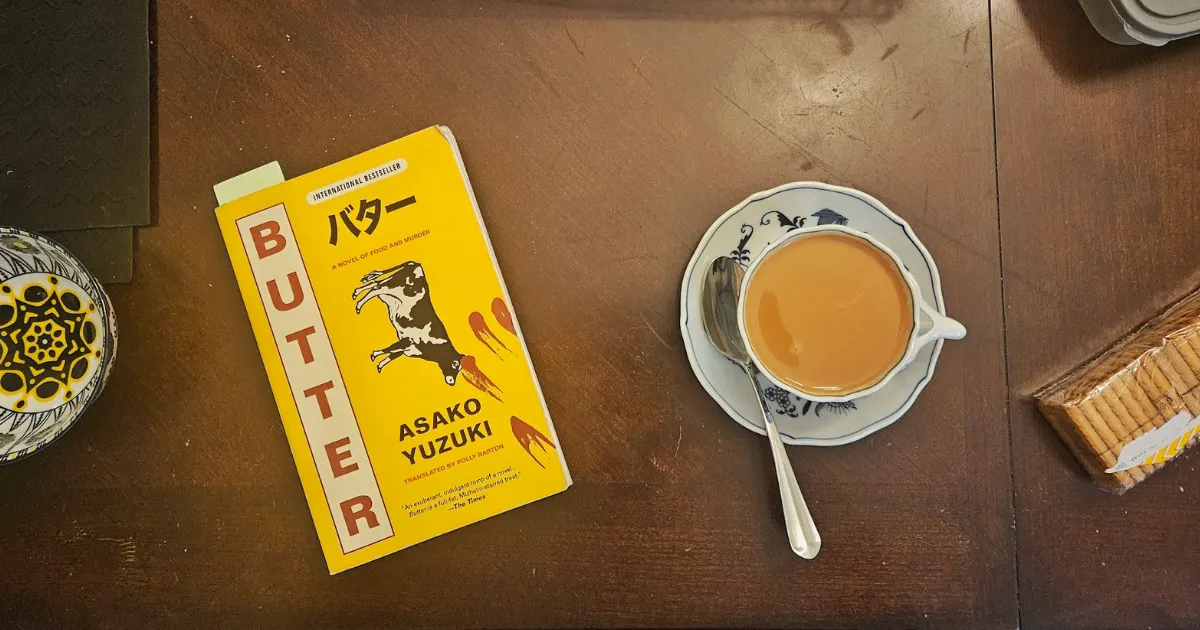

No witty, metaphoric opening line today, I haven’t the brain for that. I just recently finished reading Butter by Asako Yuzuki and loved its themes so deeply that I felt like I had to write about it. There are a lot of immediately interesting directions to talk about Butter with, but I want to focus most on the emotional shifts the book wrought in me. So forgive me, and I will only leave a tiny section to talk about the misogyny and fatphobia1.
I’ll avoid major spoilers and stick to the broad themes that are obvious from the blurb and the first few chapters, but obviously, read this at your own risk. Because I suck at a succinct description, I’m plopping the goodreads blurb for the book below:
The cult Japanese bestseller about a female gourmet cook a nd serial killer and the journalist intent on cracking her case, inspired by a true story.
There are two things that I can simply not tolerate: feminists and margarine.
Gourmet cook Manako Kajii sits in Tokyo Detention Center convicted of the serial murders of lonely businessmen, who she is said to have seduced with her delicious home cooking. The case has captured the nation’s imagination but Kajii refuses to speak with the press, entertaining no visitors. That is, until journalist Rika Machida writes a letter asking for her recipe for beef stew and Kajii can’t resist writing back.
Rika, the only woman in her news office, works late each night, rarely cooking more than ramen. As the visits unfold between her and the steely Kajii, they are closer to a masterclass in food than journalistic research. Rika hopes this gastronomic exchange will help her soften Kajii but it seems that she might be the one changing. With each meal she eats, something is awakening in her body, might she and Kaji have more in common than she once thought?
Inspired by the real case of the convicted con woman and serial killer, “The Konkatsu Killer,” Asako Yuzuki’s Butter is a vivid, unsettling exploration of misogyny, obsession, romance and the transgressive pleasures of food in Japan.
If you’re invested in the story, please turn away here and go read the book!
Pomegranate Seeds
I want to briefly talk about the social commentary before I focus on the food.
Yuzuki critiques the Japanese media with her writing. The focus of the book isn’t so much on the serial killer herself but on the way the media treats her, on their disbelief that a fat woman could ever seduce multiple men. It is an indictment on society’s refusal to see the value in women who don’t meet the impossible beauty standards of the time.
In the midst of it all you have Rika. RIka is an up-and-coming journalist who hopes to be the first woman in her paper to work on the editor’s bench. She is career-oriented and the pressures of succeeding as a woman in a male-dominated industry compound the misogynistic beauty expectations thrust on her. Even then, she rejects the almost expectation that women reporters uncover all their tips through sexual favors. Her main informant is TV commentator Yoshinori Shinoi, a man in whom she discovers an odd sort of found family. Rika has kept a slim figure throughout her life because she neglects her stomach, neglects indulgence. Convenience store meals are the norm, and food is taken for granted, is treated as its most primal self– it is just sustenance, something to power you through the work day. And of course, part of it is tied to her trauma, which I won’t spoil out here.
Rika is pursuing the “Konkatsu Killer” case and has been trying in vain to get an interview with Kajii. While meeting one day for dinner, her college friend Reiko suggests that she ask Kajii for her recipe for beef stew2. Kajii writes back and is willing to meet, as long as Rika knows that it was a recipe for beef bourguignon. Here starts the queer friendship between Kajii and Rika; as the two get to know each other Rika falls into a world of gastronomic delight, beginning with Kajii’s demand that Rika have rice with butter.
Rika attempts to grow closer to Kajii, and as part of the condition to secure an exclusive interview, starts cooking more and more. As Rika grows more confident in her palate and her body, the world begins to comment on the weight she’s gaining. There is more to be said about the sexism and fatphobia, but not by me. Apologies for the crude transition, but I want to focus on the food.
Throughout the book, food is a seductive beast that loosens down your guard and sedates you. It is, after all, how Kajii wooed and killed those three men. But it’s also a tool to discover simpler pleasures and the joy that can fill an otherwise routine task, as Rika discovers when she has butter and rice for the first time:
It was a taste that could only be described as golden. A shining golden wave, with an astounding depth of flavour and a faint yet full and rounded aroma, wrapped itself around the rice and washed Rika’s body far away.
Food is a way for friends and family to reconnect, as Rika and Reiko’s first meal of the novel sets the stage for. Food– or specifically, embracing a love of food– can loosen the grip of societal expectation. Loving the practice of cooking can fill you with a warmth like no other, especially when you cook to share, cook for others.
I have a complicated relationship with food. I’m not going to air out all of my problems in this essay because nobody really wants that, but what I enjoy most about food is the social experience that forms around it. Usually, I eat as a habit, a routine to keep myself alive. But when food becomes social it becomes fun. And the way Rika falls in love with food throughout Butter reminds me of my own thoughts around chai.
Morning has Broken
For the past year, most mornings I wake up and groggily head downstairs to unlock my front door so that one of a rotating cast of friends can come over for an early cup of chai. The purpose is threefold– 1) it gets me out of bed more reliably than a school obligation; 2) it forces me to set aside time for a morning cup of tea; and 3) it gives me some guaranteed social time with friends I might not see otherwise.
Sometimes I want some chai for my thermos and I make a few extra cups, but usually I just measure out two teacups of water into my metal pot and let them start to boil. I put in a spoon’s worth of tea powder for every cup and twice as much sugar, and garnish it with five twists of a peppercorn grinder per cup and freshly grated ginger to taste. I let it start to boil, let its color transform slowly from translucence to a golden glaze to a rich, deep, inky ochre; let the tea powder ooze out its flavor.
When it reaches its critical temperature and the bubbles start leaping out of the pot I get out my milk and pour hesitantly until its color shifts into a shade matching my memories. There’s no scientific amount here, it’s whatever feels right. It’s a little ritual, five minutes every morning where I fall in love with the kitchen again and again. And then I use my tongs and strainer to pour the tea into my little blue teacups and as they fill up the spell is broken; the kitchen is just another room again that I sometimes can’t stand to be in.
But that’s also a lie. The spell isn’t broken, the magic has just been transferred into the teacups; into something that I can drink and share with my friends. The pepper-and-ginger-tinted heat of the chai as it trickles down my gullet mingles with the warmth of the friendship I surround myself with; these are people who have made time for me to wake up and walk out of their house to meet me at seven or eight a.m. even despite the bustle of their night before.
Towards the end of the book, Rika throws a dinner party. Something about her thoughts at the end strike a chord with me:
Rika knew that nights like these when she was surrounded by friends and didn’t have to feel alone were a rare miracle. How many years would it be before there’d be another occasion like this? The knowledge of its rarity made it feel even more precious to her.
My morning chai chats aren’t a guarantee, they’re such a blessing my friends have bestowed on me! And it isn’t just surrounding yourself with people you cherish, but the act of sharing a recipe too. My recipe is a minor adaptation of my mother’s, and when I teach my friends how to make tea part of me stays with them. Yuzuki touches on this in Butter too:
[Rika] wanted to invent many more original recipes in the future, and tell someone about the best ones. It didn’t matter if that someone was a person she liked or disliked, or someone she’d never even met. If someone else could experience the journey she’d been on, and the joy she’d felt in coming up with the dish – just the thought of that prospect made Rika’s chest fizz in excitement. She wanted for these nameless recipes she’d invented to go rippling out into the world, changing colour and shape as they went, just like the drop of a hidden ingredient which you added to the soup at the very end. Rika wanted to go on living with a sense of that chain reaction stored inside her.
I’m not making my own recipes anytime soon (at least, not devising anything more than my own variations on what I know), but the way Yuzuki describes food makes me want to. Butter is just as much about the misogyny of the Japanese media as it is the love story of Rika and cooking.
I definitely recommend Butter. It was a fun read, if a tad slow at times. The plot left me guessing and was more character-driven than I expected, but it offers a delightful glance into the importance of food for connection and identity. I’ll leave you with what I choose as the thesis of this book:
This world [deserves] to be lived in… no… this world [deserves] to be tasted, greedily.
Go taste, go greed, go cherish.
Title Credits
I was struggling to get my thoughts on the page for this one, and it isn’t quite the direction I wanted everything to go in. Perhaps in a few years I’ll be back to update this. That aside, the title is from Pomegranate Seeds by Julian Moon. Food is seductive, after all, and the song ties back to Butter more than what I wrote. I also wanted to connect this book to Pushing Daisies but couldn’t find the right thread in my mind. Rest assured, a Pushing Daisies post or two is coming down the pipeline– for sure there’ll be one on season 2 episode 4 “Frescorts.” The subheading is titled off Morning has Broken by Cat Stevens, which might also be another essay’s title in the future.
Footnotes
-
And the gender. I don’t have a clear enough understanding on how gender is conceived in Japanese society, but I think there is an interesting analysis of it to make here. Rika was the prince figure in her all-girls’ high school figure and her best friend Reika often makes comments about how if only Rika were a man she’d marry her. Rika’s character seems to be torn between performing masculinity and femininity at all times. ↩
-
This was the meal she fed her third murder victim. ↩